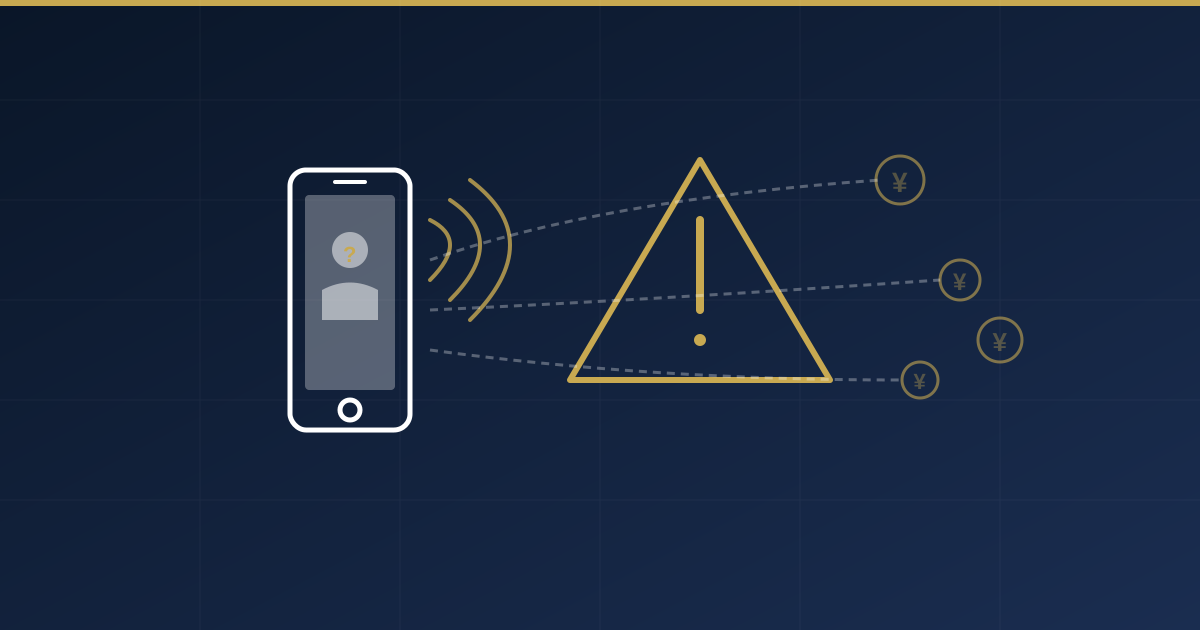
Case Overview: Record ¥1.2 Billion Phone Fraud in Ehime Prefecture
On April 6, 2026, shocking news emerged from Japan: an 80-year-old woman in Ehime Prefecture had been defrauded of approximately ¥1.2 billion (roughly US$8 million) through a phone fraud scheme. According to the National Police Agency (NPA), this represents the highest amount ever stolen from a single victim in the history of Japan's "tokushu sagi" (special fraud) category.
This case starkly illustrates how phone fraud targeting the elderly has become increasingly sophisticated and devastating. This article examines the detailed tactics used, the psychology behind the deception, cryptocurrency-based money laundering, and the legal remedies available to victims.
The Scam Tactics: A "Relay-Style" Fraud
Stage 1: The Pharmacy Employee Call
Around October 30, 2025, the victim received a phone call from a woman claiming to be a pharmacy employee.
> "Your health insurance card is being used fraudulently."
This single statement marked the beginning of what would become a ¥1.2 billion loss. By raising an urgent, relatable concern about insurance card misuse, the caller seized control of the conversation and triggered the victim's anxiety.
Stage 2: Escalation to "Police" and "Prosecutor"
Following the initial call, the victim was contacted via SNS messaging by a man claiming to be a police officer from the Ishikawa Prefectural Police, followed by another man claiming to be a prosecutor.
> "We need to investigate your assets in connection with the fraudulent use of your insurance card." > "Please transfer all of your money to the designated account."
This "relay-style" tactic — pharmacy → police → prosecutor — progressively escalated the perceived authority of the callers. For most people, instructions from a prosecutor carry enormous psychological weight, effectively overriding the victim's independent judgment.
Stage 3: Bank Transfers and Cryptocurrency Transactions
Between December 2025 and February 2026, the victim transferred approximately ¥1.2 billion through two methods:
| Method | Frequency | Details |
|---|---|---|
| Bank transfers to designated accounts | 8 times | Direct wire transfers to accounts specified by the scammers |
| Cryptocurrency transfers | Approx. 100 times | Funds converted to cryptocurrency and sent to scammer-controlled wallets |
The use of cryptocurrency for money laundering is particularly noteworthy. By conducting approximately 100 separate cryptocurrency transfers, the scammers made tracking the funds extremely difficult.
Free Tool Related to This Article
Statute of Limitations Checker
Try our free simulator related to this topic.
Try for free →Why the Victim Was Deceived: Psychological Pressure Analysis
Some may wonder how anyone could transfer ¥1.2 billion to strangers. However, phone fraud schemes are carefully engineered to exploit fundamental psychological vulnerabilities.
1. Authority Bias
By impersonating public authority figures — police officers and prosecutors — the scammers triggered an instinctive obedience response. Elderly individuals in particular tend to have deep trust in public institutions and may equate "disobeying a prosecutor's instructions" with "breaking the law."
2. Fear and Urgency
Phrases like "your insurance card has been used fraudulently" and "your assets may be connected to criminal activity" create intense fear, shutting down the victim's ability to think critically.
3. Information Isolation
Scammers typically instruct victims: "Do not discuss this with anyone, including your family — this is an active investigation." By isolating the victim from trusted advisors, they eliminate the most likely source of reality-checking.
4. Graduated Demands (Foot-in-the-Door Technique)
Starting with smaller amounts and gradually increasing them creates a psychological commitment. Once the victim has already transferred funds, a "point of no return" mentality takes hold, and losses snowball.
Cryptocurrency Money Laundering
The use of cryptocurrency (virtual currency) for money laundering in this case deserves special attention.
Traditional phone fraud relied primarily on bank account transfers, which can be frozen relatively quickly. As a result, criminal organizations have increasingly turned to cryptocurrency, which offers several advantages for illicit purposes:
| Feature | Exploitation in Fraud |
|---|---|
| High anonymity | Difficult to identify the recipient |
| Easy cross-border transfers | Enables rapid movement of funds to overseas criminal groups |
| Irreversible transactions | Once sent, funds cannot be recalled |
| Easy to split across multiple wallets | Approximately 100 transfers used to complicate tracking |
The approximately 100 cryptocurrency transactions in this case represent a technique known as "layering" — a money laundering method that disperses funds across numerous channels to make them extremely difficult to trace.
Latest Statistics: Phone Fraud Is Getting Worse
Trends in Total Fraud Losses
| Year | Total Losses | Year-on-Year Change |
|---|---|---|
| 2021 | Approx. ¥28.2 billion | — |
| 2022 | Approx. ¥36.1 billion | +28% |
| 2023 | Approx. ¥45.3 billion | +26% |
| 2024 | Approx. ¥68.2 billion | +51% |
| 2025 | Approx. ¥88.7 billion | +30% |
Total phone fraud losses in 2025 reached approximately ¥88.7 billion (about US$590 million), a roughly 30% increase from the previous year. Over five years, losses have roughly tripled, underscoring the escalating severity of the problem.
Victim Demographics
Approximately 80% of victims are aged 65 or older. Criminals specifically target pension savings and bank deposits held by elderly individuals, and their methods grow more sophisticated each year.
Types of Special Fraud (Tokushu Sagi)
| Type | Tactic | Recent Trends |
|---|---|---|
| "Ore-ore" (It's Me) Fraud | Impersonates a relative to demand cash | Evolved into authority-impersonation ("katari") type |
| Deposit Fraud | Claims the victim's account is compromised; steals bank cards | Increasing use of cryptocurrency transfer instructions |
| Fictitious Billing Fraud | Claims unpaid fees and demands payment | Uses SNS and messaging apps |
| Refund Fraud | Promises tax or insurance refunds; directs ATM operations | Also directs purchase of electronic money |
| Loan Guarantee Fraud | Demands guarantee deposits for fictitious loans | Increasingly uses fake online applications |
| Investment Fraud | Lures victims with fictitious investment opportunities | Rapid increase in SNS ad-based recruitment |
| Gambling Fraud | Sells "guaranteed winning" strategies | Online solicitation now dominant |
| Dating Introduction Fraud | Impersonates matchmaking services; collects fees | Exploits dating apps |
| Card Theft by Impersonation | Poses as police to obtain PIN; swaps bank card | Directs victims to mail cards via courier |
The Ehime Prefecture case is classified as an evolution of "ore-ore" fraud — specifically the "katari" (impersonation) type — combining relay-style escalation from pharmacy employee to police to prosecutor with cryptocurrency-based money laundering.
What to Do If You Are a Victim
If you have fallen victim to phone fraud, speed is critical for any chance of recovery.
Step 1: File a Police Report
Immediately report the crime to your nearest police station. You can call:
- Police Consultation Hotline: #9110
- Emergency: 110
Be sure to note the report acceptance number, as it will be required for subsequent procedures.
Step 2: Request Account Freezes
If you transferred money to a bank account, contact the recipient financial institution to request an account freeze.
Under the Act on Damage Recovery Benefit Disbursement from Deposits and Savings Accounts Used for Criminal Offenses (commonly known as the "Furikome Sagi Kyusai-ho" or Phone Fraud Recovery Act), victims may receive disbursements from the frozen balance of criminal accounts.
However, if the criminals have already withdrawn the funds and the balance is zero, no distribution is available. This is a race against time — act immediately upon discovering the fraud.
Step 3: Consult an Attorney
For maximum recovery, consulting an attorney is essential. An attorney can assist with:
| Service | Details |
|---|---|
| Police report preparation | Drafts a legally effective crime report |
| Account freeze requests | Files freeze requests with financial institutions on your behalf |
| Civil litigation | Pursues damages if the perpetrators are identified |
| Cryptocurrency tracing | Arranges blockchain analysis to trace fund movements |
| Recovery disbursement claims | Files claims under the Phone Fraud Recovery Act |
Contact Information
- Japan Legal Support Center (Houterasu): 0570-078374
- Consumer Hotline: 188
- Local bar associations: Contact for legal consultation appointments
Prevention Measures for Families
Families can take proactive steps to protect elderly relatives from phone fraud.
1. Regular Communication
Maintain regular contact with elderly family members and share information about current fraud tactics. The most important message: "Police and prosecutors will never ask you to send money over the phone."
2. Phone Security Measures
- Use voicemail by default: Set phones to voicemail and avoid answering unknown numbers
- Install call-blocking devices: Devices that automatically play warning messages to callers
- Enable caller ID: Verify the caller's number before answering
3. Establish a Family Code Word
Agree on a secret code word that must be confirmed whenever money is discussed over the phone.
4. Coordinate with Financial Institutions
- Lower daily transfer limits: Reduce ATM and online banking transfer limits
- Set up high-value transfer alerts: Ask the bank to contact a family member when large transfers are initiated
5. Enforce the "Never Transfer Immediately" Rule
Establish a household rule: "If money is mentioned on the phone, always consult family before taking any action." This single rule is the most effective prevention measure available.
Key Legal Provisions: Fraud Penalties
Fraud Offense Penalty Table
| Offense | Statute | Penalty |
|---|---|---|
| Fraud | Penal Code Art. 246(1) | Up to 10 years imprisonment |
| Computer Fraud | Penal Code Art. 246-2 | Up to 10 years imprisonment |
| Organized Fraud | Organized Crime Punishment Act Art. 3(1)(xiii) | 1 year to 20 years imprisonment |
| Concealment of Criminal Proceeds | Organized Crime Punishment Act Art. 10 | Up to 5 years imprisonment and/or fine up to ¥3 million |
| Receipt of Criminal Proceeds | Organized Crime Punishment Act Art. 11 | Up to 3 years imprisonment and/or fine up to ¥1 million |
Enhanced Penalties for Organized Crime
Phone fraud is almost always prosecuted under the Organized Crime Punishment Act, which carries significantly heavier penalties than ordinary fraud. While standard fraud under the Penal Code is punishable by up to 10 years imprisonment, organized fraud carries a penalty of 1 to 20 years imprisonment — effectively doubling the maximum sentence.
Additionally, cryptocurrency-based money laundering may constitute concealment of criminal proceeds, which is prosecuted as a separate offense alongside the underlying fraud charge.
"Receivers" and "Withdrawers" Face Serious Penalties Too
The individuals who physically collect cash from victims ("ukeko" or receivers) or withdraw cash from ATMs ("dashiko" or withdrawers) are prosecuted as accomplices and face the same penalties as the masterminds. The excuse "I thought it was just a part-time job" carries no legal weight.
In recent years, there has been a sharp increase in the recruitment of receivers and withdrawers through SNS "yami-baito" (dark part-time job) postings. Young people unwittingly becoming accomplices to serious organized crime has itself become a significant social issue in Japan.
Summary
The case of an 80-year-old woman in Ehime Prefecture losing approximately ¥1.2 billion has cast a stark light on the severity of phone fraud in Japan.
- Phone fraud losses are increasing year after year, reaching approximately ¥88.7 billion in 2025
- The relay-style tactic — pharmacy employee → police → prosecutor — is highly sophisticated
- Cryptocurrency-based money laundering makes recovery extremely difficult
- Approximately 80% of victims are aged 65 or older; family support is essential
- If victimized, take three steps immediately: file a police report → request account freezes → consult an attorney
Police officers and prosecutors will never ask you to send money over the phone. If you receive a suspicious call, consult your family first and call #9110 (Police Consultation Hotline).
If you are considering pursuing recovery of fraudulently obtained funds or filing a criminal complaint, please consult an attorney as soon as possible. The longer you wait, the more difficult it becomes to trace and recover the stolen funds.