Case Overview
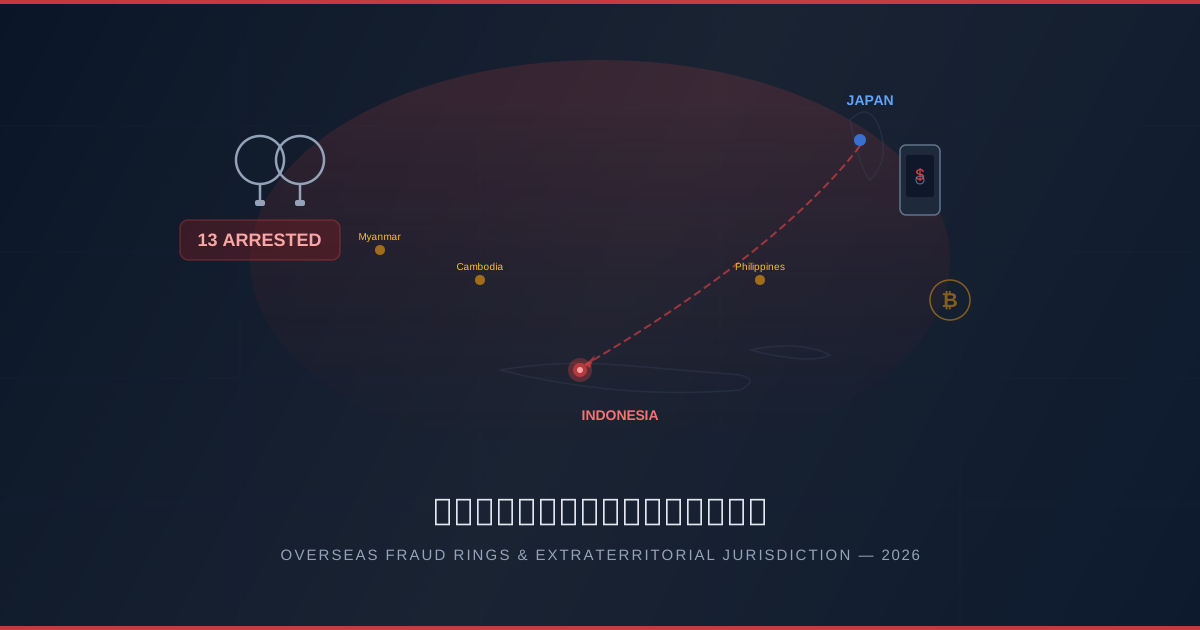
On April 16, 2026, a joint task force of the Tokyo Metropolitan Police Department and the Nara Prefectural Police arrested 13 Japanese nationals on fraud charges for operating a phone fraud ring from a base near Jakarta, Indonesia, targeting victims in Japan.
Evidence Seized
According to police announcements, the following items were seized from the operation base:
- Clothing with "Investigation Division 2" badges: used to impersonate police officers
- Detailed conversation manuals: scripts for phone calls to victims
- Multiple mobile phones and SIM cards: used to make calls to Japan
- Cryptocurrency transaction records: evidence related to money laundering
This marks the first-ever crackdown on a Japanese fraud group operating out of Indonesia.
---
The Rise of Overseas Fraud Bases
In recent years, phone fraud groups have increasingly relocated operations abroad to evade Japan's strengthened domestic enforcement.
Major Overseas Fraud Base Crackdowns
| Country | Timeline | Details |
|---|---|---|
| Cambodia | 2023-- | Multiple Japanese groups busted; some operated from entire buildings near Phnom Penh |
| Philippines | 2023-- | Highlighted by the "Luffy" case; orders issued from immigration detention facilities near Manila |
| Myanmar | 2024-- | Groups exploited border zone special economic zones and political instability |
| Indonesia | April 2026 | First-ever crackdown; base near Jakarta |
Why Groups Operate from Abroad
- Outside Japanese police jurisdiction: international cooperation takes time
- Low operational costs: cheaper rent and labor than Japan
- Communications technology: VoIP and VPN enable calls from Japanese numbers overseas
- Limited local enforcement priority: crimes between Japanese nationals may not be a priority for local authorities
---
Free Tool Related to This Article
Statute of Limitations Checker
Try our free simulator related to this topic.
Try for free →Extraterritorial Application of Japanese Criminal Law
Basic Principles
Japanese criminal law generally adopts the territorial principle (crimes must occur within Japan), but exceptions allow extraterritorial application.
Penal Code Article 3 (Crimes Committed Abroad by Japanese Nationals)
Japanese criminal law applies to certain serious crimes committed by Japanese nationals outside Japan.
| Applicable Offenses | Relevance to This Case |
|---|---|
| Fraud (Penal Code Art. 246) | Core offense directly applicable |
| Computer fraud (Art. 246-2) | Online fraud methods |
| Theft (Art. 235) | Unauthorized withdrawals from accounts |
| Robbery (Art. 236) | Depending on the conduct of money collectors |
Penal Code Article 3-2 (Crimes Against Japanese Nationals Abroad)
When Japanese nationals are victims, Japanese criminal law applies even if the perpetrators are foreign nationals. While the victims in this case are Japan-based residents making direct application straightforward, this provision becomes important when foreign co-conspirators are involved.
Penal Code Article 8 (Application to Offenses Under Other Laws)
The general provisions of the Penal Code (including extraterritorial application) also apply to offenses under other statutes, extending the framework to special laws such as the Organized Crime Punishment Act.
---
Application of the Organized Crime Punishment Act
The Act on Punishment of Organized Crimes and Control of Crime Proceeds provides for enhanced penalties for organized fraud of the type seen in this case.
Enhanced Penalties for Organized Fraud
| Standard Fraud | Organized Fraud |
|---|---|
| Up to 10 years imprisonment | 1 to 20 years imprisonment |
"Organized" means the crime was committed as an activity of a group, carried out by an organization established for the purpose of committing crimes. Cases with clear role divisions -- callers ("kake-ko"), money collectors ("uke-ko"), and command hierarchy -- are strong candidates for application of this act.
Confiscation and Collection of Criminal Proceeds
The act provides for confiscation and collection of criminal proceeds. Cryptocurrency can be subject to confiscation if identified as criminal proceeds, though practical enforcement remains challenging.
---
Cryptocurrency Money Laundering
In this case, the group allegedly converted fraudulently obtained funds into cryptocurrency for money laundering purposes.
Typical Cryptocurrency Laundering Methods
- Fund transfer: victims are directed to send money to accounts controlled by the group
- Conversion to cryptocurrency: funds are used to purchase crypto on exchanges
- Mixing: funds are routed through multiple wallets to obscure the trail
- Cashing out abroad: converted to cash on exchanges in countries with weaker regulations
Challenges in Fund Recovery
When cryptocurrency laundering is involved, recovering victim funds is extremely difficult:
- Pseudonymity: blockchain transactions are public, but wallet owners are hard to identify
- Cross-border nature: funds flow through wallets and exchanges in multiple countries
- Speed: digital transfers complete in minutes, often outpacing freeze orders
- Regulatory gaps: seizure and confiscation procedures for crypto assets are not harmonized internationally
---
Legal Procedures When Arrested Abroad
If Arrested in Indonesia
- Arrest and detention under local law: Indonesian criminal procedure applies
- Consular notification: notification to the Japanese Embassy or Consulate in Indonesia (Vienna Convention Art. 36)
- Extradition: Japan and Indonesia do not have an extradition treaty, requiring diplomatic channel negotiations
- International legal assistance: evidence sharing proceeds under the International Assistance in Investigation Act
Procedures After Transfer to Japan
Once transferred to Japan, standard Japanese criminal procedure applies:
- Arrest: transfer to prosecutor within 48 hours
- Detention: up to 20 days (including extensions)
- Indictment: prosecution decision made during the detention period
- Trial: organized crime cases may be subject to lay judge (saiban-in) trials
---
Protecting Yourself from Fraud
Common Phone Fraud Tactics
- Impersonating police or prosecutors: "Your bank account has been used in a crime"
- Tax refund fraud: directing victims to ATMs for supposed refunds
- Fictitious billing: demanding payment via convenience store gift cards
- Cash card fraud: visiting homes to collect bank cards under false pretenses
Prevention Tips
- Police and prosecutors will NEVER request money over the phone
- If you receive a suspicious call, hang up and call back using the official number
- "Act now" and "don't tell anyone" are classic fraud keywords
- Establish a code word with family members
- Set your home phone to always go to voicemail
---
Consultation Resources
| Resource | Contact | Services |
|---|---|---|
| Police Consultation Hotline | #9110 | General fraud victim support |
| Emergency | 110 | When currently being victimized |
| Consumer Hotline | 188 | Fictitious billing and fraud consultations |
| Japan Legal Support Center (Houterasu) | 0570-078374 | Lawyer referrals and legal aid |
| Bank fraud account freeze | Receiving bank's toll-free number | Request immediate account freeze after transfer |
---
Summary
The arrest of 13 Japanese fraud suspects in Indonesia demonstrates that overseas phone fraud operations have expanded across Southeast Asia -- from Cambodia, the Philippines, and Myanmar, now to Indonesia.
Three key takeaways:
- Japanese criminal law applies even to crimes committed abroad -- Penal Code Articles 3 and 3-2 ensure extraterritorial prosecution
- The Organized Crime Punishment Act enhances penalties -- from a 10-year maximum to up to 20 years
- Cryptocurrency laundering makes fund recovery extremely difficult -- report to police and request account freezes immediately
The belief that "you can't get caught if you're overseas" is completely wrong. International investigative cooperation frameworks are strengthened every year, and this case demonstrates that crackdowns in cooperation with Indonesian authorities are now a reality.
If you have been a victim of fraud, contact the police (#9110) immediately and request an account freeze from the receiving bank. The longer you wait, the harder it becomes to recover the stolen funds. If you are considering filing a criminal complaint or pursuing civil damages, we strongly recommend consulting with an attorney as soon as possible.