Introduction: Japan's Speed Limit Cut in Half
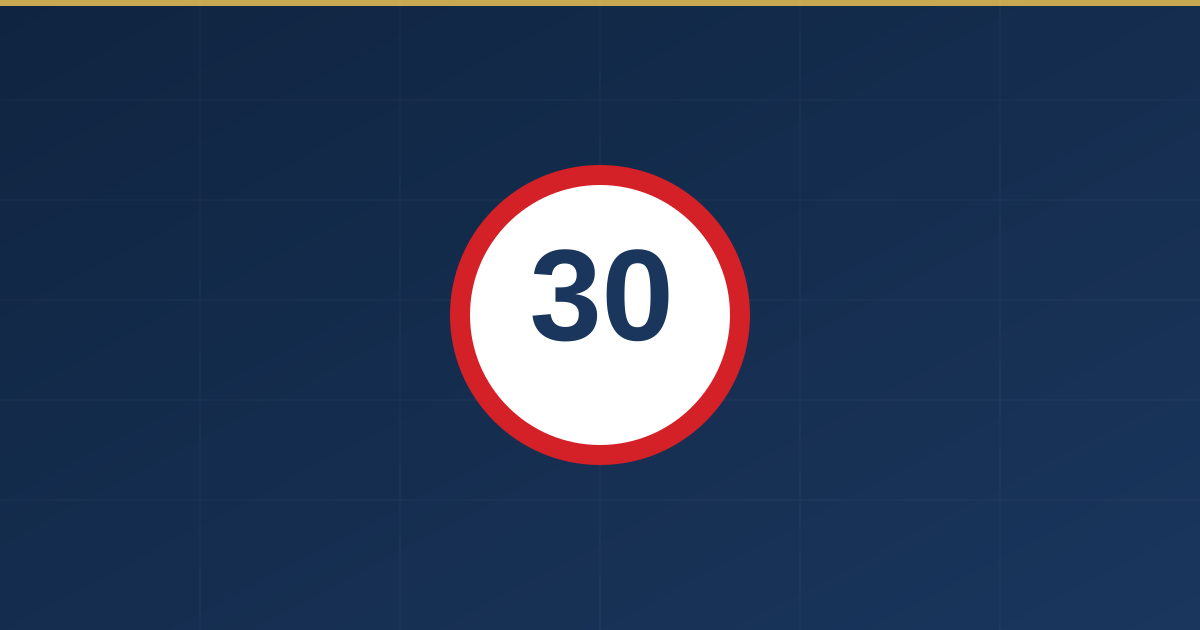
On September 1, 2026, an amendment to Japan's Road Traffic Act Enforcement Order takes effect, bringing a major change to default speed limits on public roads. Specifically, the statutory speed limit on roads without center lines or lane markings — commonly known as residential roads (seikatsu doro) — will be reduced from 60 km/h to 30 km/h.
This change is based on an amended cabinet order (Cabinet Order No. 183 of 2024), promulgated in May 2024 with a September 1, 2026 effective date.
While "halving the speed limit" sounds dramatic, in practice it means that narrow residential streets — where the legal limit was technically 60 km/h simply because no speed sign was posted — will now have a default limit that matches actual safe driving speeds.
Why This Change Was Made
According to National Police Agency data, approximately 70% of fatalities and serious injuries on residential roads (under 5.5 m width) involve pedestrians and cyclists. The previous 60 km/h default was designed for arterial roads and was clearly inappropriate for narrow neighborhood streets.
Research also shows that pedestrian fatality rates rise sharply when vehicle speeds exceed 30 km/h, while staying at or below 30 km/h significantly reduces the risk of fatal outcomes — a key justification for the reform.
What Counts as a "Residential Road"?
Criteria for the New 30 km/h Limit
The 30 km/h default applies to roads meeting all of the following conditions:
- No center line (no painted line dividing opposing traffic)
- No lane markings (no lines separating lanes in the same direction)
- No posted speed limit sign
These are typically narrow roads found in residential neighborhoods, shopping streets, and back alleys.
How to Tell at a Glance
| Checkpoint | 30 km/h applies | Does NOT apply |
|---|---|---|
| Center line on the road? | No line → Applies | Line present → Does not apply |
| Lane markings? | None → Applies | Present → Does not apply |
| Speed limit sign posted? | None → 30 km/h default | Sign present → Follow the sign |
Important: If a speed limit sign is posted (e.g., "40"), that sign's speed applies. The 30 km/h default is only for roads with no posted limit.
Comparison: Affected vs. Unaffected Roads
| Feature | Affected (30 km/h) | Unaffected (60 km/h default) |
|---|---|---|
| Center line | None | Present |
| Lane markings | None | Present |
| Typical roads | Narrow residential streets, alleys | Single-lane or multi-lane roads |
| Speed signs | None (statutory default applies) | None (statutory default) or sign posted |
| Approximate width | Under 5.5 m | 5.5 m or wider |
| Primary users | Pedestrians, cyclists | Motor vehicles |
Free Tool Related to This Article
Statute of Limitations Checker
Try our free simulator related to this topic.
Try for free →Roads NOT Affected
The following roads retain the conventional 60 km/h statutory speed limit (or their posted limit):
- Roads with center lines: Any road with a painted center line
- Roads with lane markings: Any road with lane divisions
- Roads with medians: Physically divided roads
- Expressways and motor vehicle-only roads: Statutory 100 km/h (120 km/h on certain sections)
Note that one-way streets without center lines or lane markings are subject to the new 30 km/h limit.
Speeding Penalties Table
With the statutory limit dropping to 30 km/h, speeds that were previously legal could now constitute speeding violations. For example, driving at 45 km/h on a residential road was legal before, but after the amendment it is a 15 km/h violation.
Penalties for Speeding on General Roads
| Speed Over Limit | Demerit Points | Fine (Standard car) | Fine (Large vehicle) |
|---|---|---|---|
| Under 15 km/h | 1 point | ¥9,000 | ¥12,000 |
| 15–19 km/h | 1 point | ¥12,000 | ¥15,000 |
| 20–24 km/h | 2 points | ¥15,000 | ¥20,000 |
| 25–29 km/h | 3 points | ¥18,000 | ¥25,000 |
| 30–49 km/h | 6 points | Criminal fine (summary court) | Criminal fine (summary court) |
| 50 km/h or more | 12 points | Criminal fine (summary court) | Criminal fine (summary court) |
Critical point: Driving at 50 km/h on a residential road after the amendment means a 20 km/h violation (2 demerit points, ¥15,000 fine). Driving at 60 km/h means 30 km/h over the limit — an automatic license suspension (6 points) plus a criminal penalty instead of a simple traffic fine.
Before vs. After Comparison
| Driving Speed | Before (60 km/h limit) | After (30 km/h limit) |
|---|---|---|
| 35 km/h | Legal | 5 km/h over |
| 40 km/h | Legal | 10 km/h over (1 point) |
| 50 km/h | Legal | 20 km/h over (2 points, ¥15,000) |
| 60 km/h | Legal | 30 km/h over (6 points, suspension, criminal fine) |
Impact on Accident Liability
The speed limit change has significant implications for fault allocation (kashitsu wariai) in traffic accident cases.
Speed Violations as a Liability Modifier
Fault percentages in traffic accidents are determined by adjusting a base ratio with various modifying factors. Speeding is a major modifier that increases fault.
| Degree of Speeding | Fault Percentage Adjustment |
|---|---|
| 15 km/h or more over the limit | Approximately +10% |
| 30 km/h or more over the limit | Approximately +20% |
Consider a scenario where a car traveling at 50 km/h on a residential road strikes a pedestrian:
- Before the amendment: Within the 60 km/h limit, so no speeding modifier → base fault ratio applies
- After the amendment: 20 km/h over the new 30 km/h limit → fault percentage increases by +10–15%
The same driving speed produces a dramatically different liability outcome due to the change in statutory speed limit.
Impact on Damages
Changes in fault allocation directly affect compensation amounts. In an accident with ¥10,000,000 in damages, a 10% increase in the driver's fault adds ¥1,000,000 to the compensation owed.
Tips for Drivers
1. Check Your Regular Routes
Review your commuting and daily driving routes for roads without center lines. Any such roads will have a 30 km/h limit from September 1, 2026.
2. Build a Speedometer-Checking Habit
On residential roads, make it a habit to check your speedometer frequently to stay under 30 km/h. Pay special attention right after turning from a wider road onto a narrow street, when you are most likely to be traveling too fast.
3. Use Navigation and Speed Alert Features
Modern car navigation systems and smartphone map apps often include speed limit display and warning features. These are expected to be updated to reflect the new law — make full use of them.
4. Follow Posted Signs Where Present
On residential roads that already have posted speed signs (e.g., 20, 30, or 40 km/h), the posted sign takes priority. The new 30 km/h default only applies where no sign is posted.
5. Stay Informed Before Your Next License Renewal
This amendment affects a large number of drivers and is expected to be covered in license renewal courses. However, if you renewed your license before the effective date, you may not receive this information in a course — proactively educate yourself.
Effective Date and Transition Measures
Effective Date
September 1, 2026
From this date, the statutory speed limit on roads without center lines or lane markings becomes 30 km/h, and enforcement begins.
Transition Period
As of the current announcement, no grace period or transition measures have been established. The 30 km/h limit takes effect uniformly on the effective date.
However, the National Police Agency has indicated plans to intensify public awareness campaigns before the effective date, and JAF (Japan Automobile Federation) is also distributing information to members. While warning-focused enforcement is possible in the initial period after implementation, the law technically permits full enforcement from day one.
Signage
Some municipalities are considering installing supplementary signs or road surface markings to indicate that the 30 km/h statutory limit applies. However, given the enormous number of affected roads nationwide, signs will not be placed on every road. Drivers must operate under the assumption that 30 km/h applies even without signage.
Summary
The September 1, 2026 implementation marks a major turning point in Japanese traffic regulations:
- The default speed limit on roads without center lines or lane markings drops from 60 km/h to 30 km/h
- Driving at speeds that were previously normal could result in license suspension
- The change directly affects fault allocation in traffic accident liability
This is a reform that every driver in Japan needs to know about, especially because "normal" driving speeds will suddenly become violations. Review your driving routes before the effective date and prioritize safe driving.
For consultations regarding traffic accidents or speeding violations, contact a lawyer with expertise in traffic accident law.